
AI and Landscape Design – Will it Help or Hinder?

CEO & Garden Designer
Ruth Marshall
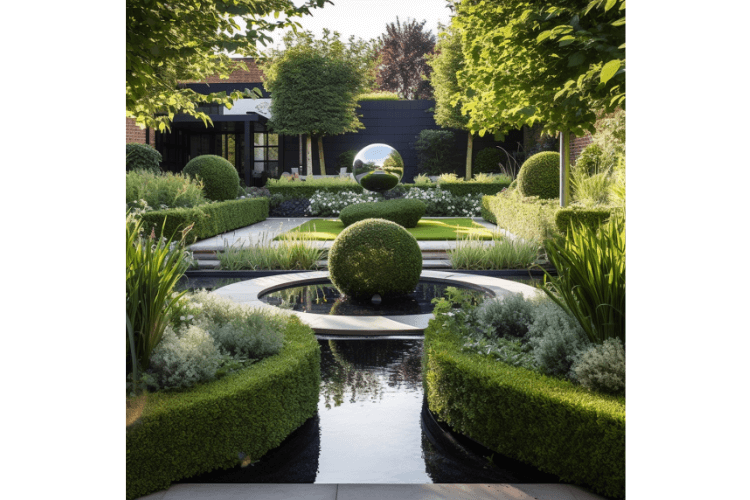
When we share our 3D designs with clients, they sometimes exclaim, “Isn’t this software clever?”
At that point our design team may bristle slightly. The software is indeed clever, but the design is not coming from the software, it is coming from the skill of the designer. It comes from their understanding of the site and the brief. It is informed by the ideas that go round their heads when seeing the site and talking to the clients, and the inspirations they draw from everything they see around them. Their ability to “tune-in” to what will work for that particular client is largely unteachable, but is a core skill that develops over the years, as does their experience of what is practical, and buildable, what will age well and what will genuinely enhance the way someone lives in their garden.
The 3D visualisation is simply that. A visualisation. A tool to communicate all of that thinking.
Even before the recent explosion of AI, we were all seeing extraordinary photoreal renders. We create many ourselves. Some represent excellent, well considered designs. Others are simply beautiful pictures. It can already be difficult to tell the difference. I suspect that is about to become harder.
What AI Can Do Now
AI is currently very good at helping to communicate ideas. If a client wants to see a firepit in a swimming pool, or a haha against a modern house we can create an image of this inside a few minutes.
If we are trying to describe a particular garden atmosphere or subtle planting character and we do not have an existing image that quite captures it, AI image tools can help generate something close. There are thousands of nuances in garden design and it is impossible to have a reference image for every one. Used carefully, AI can help bridge that gap.
There are of course ethical questions around data sources and copyright which the industry will need to keep under review. At present, however, AI generated images are not copyrighted in the conventional sense, and prompts can be refined to create something that conveys the intended feel.
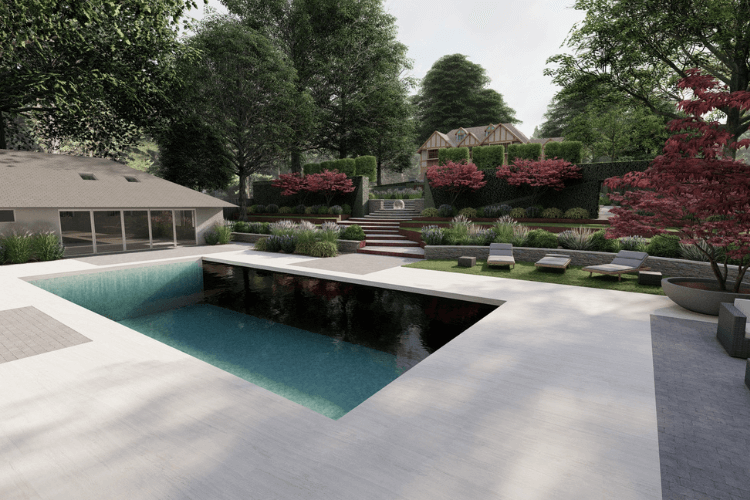
Render programmes such as Lumion can also transform relatively simple 3D outputs into highly photoreal visuals. In our experience, the more “real” something looks, the more professional it can appear. That perception can be misleading. Rendering software adds layers of detailing, lighting and texture to enhance realism. This can be extremely helpful in communicating a design. But it remains only as good as the thinking behind it.
AI can also significantly reduce administrative burden. Drafting documents, refining written material, interrogating planning policy, even improving the way we search for technical information. Used intelligently, it saves time. And time is one of the most valuable resources in any design practice.
What AI Cannot Yet Do
At present, AI cannot be told what you want to achieve for a specific client, on a specific site, with specific constraints, and be left to produce a resolved, workable design.
It cannot fully interpret levels, drainage, soil conditions, neighbouring properties, tree protection constraints, access for construction, long term maintenance requirements and budget realities, and weave them together into a coherent spatial strategy.
Lidar scanning is excellent for buildings, courtyards and balconies and can drop these into a 3D model. For gardens, it is less effective (see below). That may improve. One assumes it will although it is currently expensive (and uneconomic) to get these simplistic scans converted to a format that is useful for landscape work. There will almost certainly be programmes that can analyse multiple potential solutions to complex design problems and generate options.

But even then, those options will need interpretation.
AI is pattern led. Landscape design is site led.
The Impact on the Creative Industries
There is no doubt that parts of what we do will be done more quickly and more cheaply by AI. It would be naïve to pretend otherwise. It will happen.
For many people, particularly those without the budget for a full design service, AI will provide access to ideas and imagery that were previously out of reach. In that sense it is democratising. And that is not necessarily a bad thing.
The question often asked is whether designers should be worried about being replaced.
In my view, no.
Our clients are not coming to us simply for a picture of what their garden might look like. They are coming for knowledge and conversation. For judgement. For someone to challenge assumptions, refine ideas, and apply experience. They want something that is beautiful, practical, implementable and manageable. That is a far broader brief than producing a compelling image. In fact developing the detailing is often the largest chunk of the work and is often undervalued or not even considered at the start! (see Value of Landscape Detailing)
I was reminded of this when looking at interior mood boards myself. I felt like a child in a sweetshop. Everything looked wonderful. I had no idea what would actually work in my home, what it would cost and how to achieve any of those options. It was only when I employed an excellent interior designer that the options narrowed into something coherent and right for me (and in fact nothing like the moodboards I had started with!).
The same applies to gardens.
The Risk of Sameness
One thing I notice when reviewing AI generated imagery is that after a while it begins to feel similar. Polished. Atmospheric but slightly interchangeable.
AI recombines what already exists. It does not have lived experience of a particular site. It does not walk it in the rain. It does not notice the way the light falls at four o’clock in the afternoon. It does not understand how a family actually uses their outdoor space.
In a real garden you cannot replicate a static image- if you get too wedded to a single view (however glamorous) you are missing out on the fact that the garden will change during a single day, in different light and weather conditions, through the seasons, and particularly over time. The client will inevitably be disappointed if they fixate on a point in time that was never exactly achievable anyway. The art of visualisation is to get across a “feel” of a garden not just an image (see also The art of visualising designs for garden design projects) . The visualisation supports and prompts the conversations and the detailing- it cannot at this stage replace it.
Our strength as designers lies in producing unique solutions grounded in place. Gardens are not images. They are living systems that evolve over decades.
Our Position at CGLA
At CGLA, we are cautiously embracing the available technologies. We are exploring where they support our skills, where they save time, and how they might allow us to focus more energy on the elements our clients truly value. We revel in some funky graphics, but these are the icing on the cake not the cake!
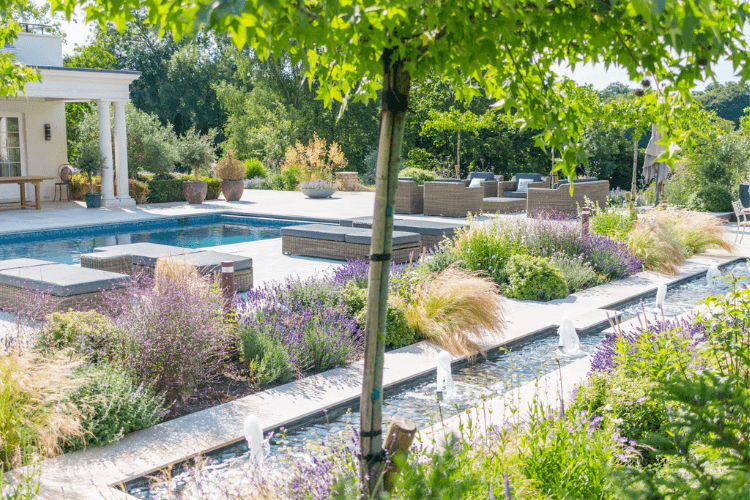
What our clients want is a garden not an AI image of one, and putting in place the right steps to help them get there as painlessly as possible is always a process we should be looking to improve.
We are clear that ignoring AI would be short sighted. Equally, slavishly embracing it would undermine what makes our work distinctive. The art of landscape design goes way beyond producing a few static images
If we do not use these tools intelligently, we risk falling behind. But we will not rely on them to replace knowledge, experience or creative judgement. At present, AI has no creative eye. It can generate impressive imagery, but it does not yet have discernment, restraint or soul.
Ultimately, our proposition rests on thoughtful design, technical rigour and a deep understanding of landscape as a living medium. We are confident that this remains, and will continue to remain, something our clients prize.
CGLA are an award winning team of Garden Designers, Landscape Architects, Landscapers and Garden Maintenance Operatives working in Buckinghamshire, London and the South East, as well as on prestigious design projects across the UK and abroad. We are currently working in Oman, Jersey and France, and welcome enquires for design, landscaping or garden maintenance. Contact us here
