
Designing a Garden for a New Build Home

CEO & Garden Designer
Ruth Marshall
New build homes cover an enormous range of property types, from modest infill plots to substantial country houses. Despite that variation, there are some consistent themes and considerations that apply to almost all projects.
Even with small spaces, designing the landscape well and alongside the emerging house design will pay dividends in terms of the quality of the overall results, the efficiency of the process and timings, and the likely costs.
-
Planning Matters
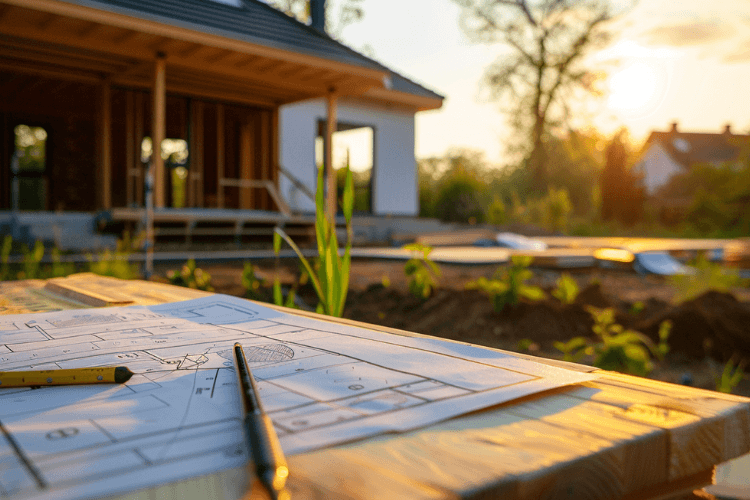
With planning permission taking longer than ever, and costs continuing to rise, it is essential to approach your project holistically from the outset.
Biodiversity Net Gain (BNG) is now almost always a requirement. We have covered this in detail here, but in short, most new developments must demonstrate a minimum 10% uplift in biodiversity. This is ideally delivered on site and comes with a 30-year management commitment.
If not properly considered early on, this legislation can have a significant financial impact, sometimes adding tens or even hundreds of thousands of pounds to a scheme.
Landscape design also forms part of the planning process. Even relatively straightforward applications typically require some level of landscape input alongside the BNG strategy. Larger or more sensitive sites may also require detailed planting plans, visual impact assessments, and supporting documentation.
These are substantial pieces of work in their own right and can easily delay an application if left too late.
Key message: Planning is now a coordinated, multi-disciplinary exercise for all but the simplest of new builds. Early, joined-up thinking will save time, cost and frustration.
2. Value for money: cost savings and efficiencies
There are very real efficiencies to be gained when the landscape is considered early in the process.
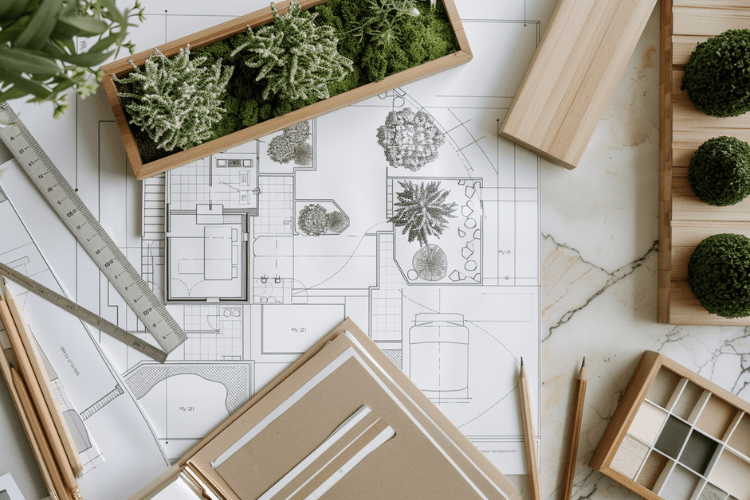
Design essential elements properly, first time. Most new builds require a driveway, retaining structures, a principal terrace, and access paths. These are unavoidable costs. With careful design, they can be both functional and visually coherent with the house, rather than feeling like an afterthought.
These elements are also expensive, so it makes sense to design them once, and design them well.
VAT efficiencies. Works included within the main planning consent can often be zero-rated alongside the new build (see blog saving money when landscaping new build houses). This can represent a substantial saving if addressed early.
Coordinate with services and infrastructure. Drainage runs, manholes, air source heat pumps, and service connections are frequently left in locations that later compromise the garden. Many of these can be adjusted during early design stages, but become fixed once construction is underway.
Avoiding a manhole in the middle of a lawn, or a service run through a key tree location, is far easier than trying to resolve it later.
Plan levels and earthworks carefully. Managing cut and fill across a site can have a major cost impact. While some excavated material may need to be removed, larger plots often allow for reuse on site. A considered earthworks strategy can save tens of thousands of pounds.
Key message: Even if the full garden is not installed immediately, it is best designed in full. This ensures everything works together and avoids costly rework.
3. Creating a sense of place
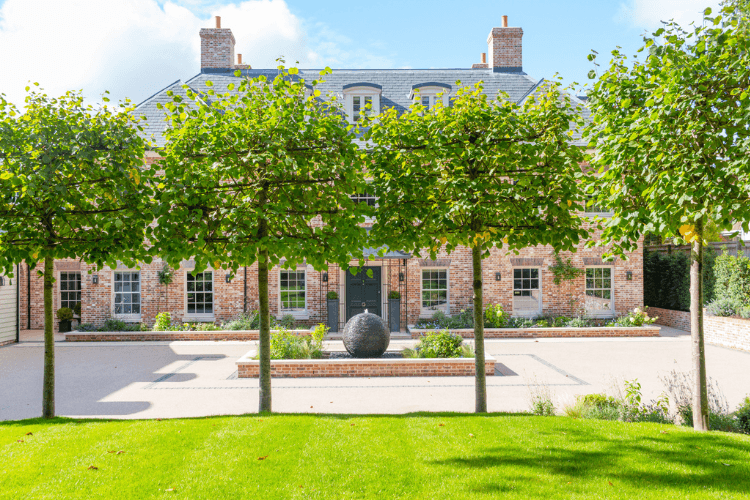
One of the biggest opportunities with a new build is the ability to create an immediate sense of maturity and belonging.
Structure and views. Establishing long views, framing features, and organising the space into coherent areas are fundamental to good garden design. On a new build site, where there may be little existing character, these principles are even more important.
The relationship with the house. Modern homes tend to have extensive glazing. This places greater emphasis on views from inside, as well as on privacy and solar control.
Thoughtful planting and spatial design can significantly enhance the experience of the house itself.
Outdoor living. Entertaining outside is now a priority for most families. Creating seamless connections between interior and exterior spaces, with well-designed terraces and transitions, allows the house and garden to function as a unified whole.
4. Timeframes and phasing
Not everything needs to be delivered at once, but some elements should not be delayed.
Groundworks, levels, drainage, and primary hard landscaping are best completed alongside the build. These are disruptive and difficult to retrofit later.
Structural planting, particularly trees, is also worth doing early. Even a small number of well-placed trees will begin to establish scale and soften the newness of the site.
Secondary planting and finer details can often be phased over time, allowing budgets to be managed more comfortably without compromising the overall vision.
5. Soil and site preparation
This is one of the least visible, but most critical, aspects of any new build garden.
Construction activity often leaves behind compacted subsoil, poor-quality topsoil, and, in some cases, buried debris. Without proper remediation, planting will struggle to establish and long-term performance will be compromised.
Investing in soil preparation at the outset underpins everything that follows.
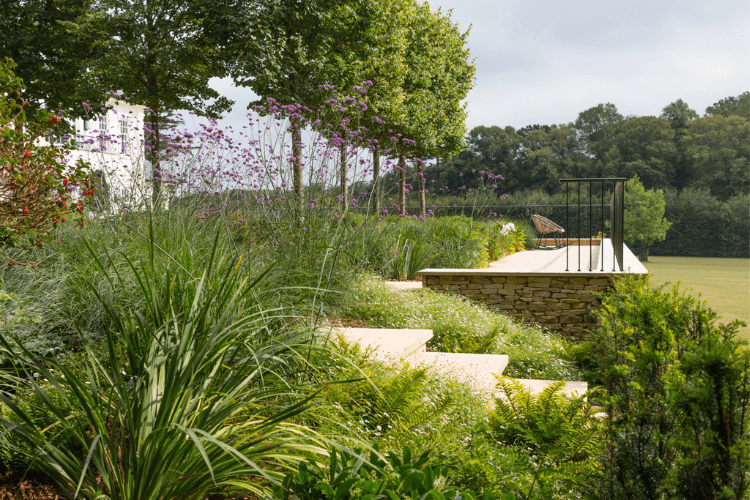
Trees play a disproportionate role in how a new garden feels.
Where possible, existing trees should be retained and incorporated into the design. Where they are not present, early planting of key structural trees helps to establish scale, provide enclosure, and create a sense of permanence.
As with services, their positioning needs to be considered early to avoid conflict later.
7. Long-term management
A successful garden is not just about how it looks on completion, but how it performs over time.
This is particularly relevant in the context of BNG, where a 30-year management commitment is required. More broadly, all gardens benefit from being designed with realistic maintenance in mind.
There is little value in creating something that cannot be properly cared for.
Early stewardship, particularly in the first two to three years, is also critical in ensuring the garden establishes as intended.
Final thoughts
A new build offers a rare opportunity to shape both house and landscape together.
Approached properly, this results in a cohesive, well-functioning environment that feels considered from the outset. Left too late, the landscape becomes a series of compromises around decisions that are already fixed.
The difference, in both cost and outcome, is significant.
At CGLA, we specialise in working alongside clients and architects on new build homes, guiding projects from initial vision through to a fully realised landscape. Our experience ensures the garden is not an afterthought, but a fundamental part of the design from the outset. If you are planning a new build, we would be very pleased to discuss how we can help.
CGLA are an award winning team of Garden Designers, Landscape Architects, Landscapers and Garden Maintenance Operatives working in Buckinghamshire, London and the South East, as well as on prestigious design projects across the UK and abroad. We are currently working in Oman, Jersey and France, and welcome enquires for design, landscaping or garden maintenance. Contact us here
